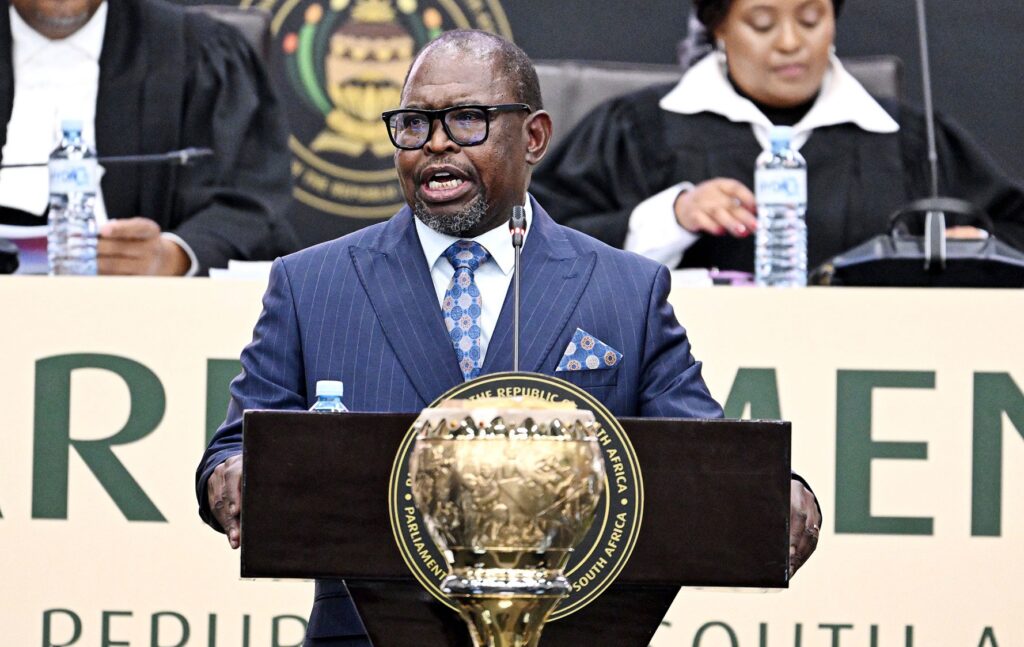


On 25 February 2026, Finance Minister Enoch Godongwana tabled South Africa’s National Budget for the 2026/27 fiscal year, describing it as a decisive “turning point” in the country’s public finances.
National Treasury projects that public debt has reached its peak and will now stabilise before gradually declining as a percentage of GDP. The budget deficit is also narrowing, supported by improved revenue collection and continued spending discipline.
Investor sentiment appears to be improving. South Africa recently secured its first credit rating upgrade in more than a decade and was removed from the Financial Action Task Force (FATF) grey list — two developments Treasury believes signal renewed global confidence in the country’s financial governance.
Economic growth, however, remains subdued. The economy is expected to expand by around 1.5% in the short term, gradually rising to about 2% by 2028. Treasury attributes this modest recovery to ongoing structural reforms and increased infrastructure investment.
Notably, the Minister announced no broad-based tax hikes. Earlier proposals for significant increases were withdrawn after stronger-than-expected revenue performance, particularly from the mining sector. Personal income tax brackets and rebates were adjusted in line with inflation to prevent bracket creep and protect households’ purchasing power.
To encourage savings and long-term investment, the annual tax-free savings account limit has been increased, alongside higher retirement fund deduction caps. However, targeted increases will apply to excise duties on alcohol and tobacco, as well as modest adjustments to fuel and carbon levies.
Total consolidated government spending for 2026/27 stands at approximately R2.67 trillion. Social protection remains central, with above-inflation increases to social grants, including old-age and disability grants. More than 26 million South Africans are expected to benefit.
Education and healthcare continue to receive significant allocations. Funding will support basic education, early childhood development, school nutrition programmes, provincial health services, and HIV/AIDS interventions.
Peace and security allocations have also been strengthened, with additional funding directed to the defence force, police services, border management, and the judiciary to reinforce law enforcement capacity and uphold the rule of law.
Structural reforms in the energy and logistics sectors remain a key priority. Government aims to address electricity supply challenges and ease congestion at rail lines and ports — bottlenecks that have constrained economic growth in recent years.
Treasury further announced plans to introduce a principles-based fiscal anchor designed to entrench long-term discipline and safeguard debt sustainability.
Overall, Budget 2026 attempts to strike a balance between fiscal consolidation, social protection, and economic reform. By stabilising debt, avoiding sweeping tax increases, prioritising infrastructure and public services, and supporting vulnerable households, government is positioning this budget as a foundational step toward sustainable growth.
Whether this marks a true turning point will depend not only on policy commitments, but on consistent implementation in the years ahead.