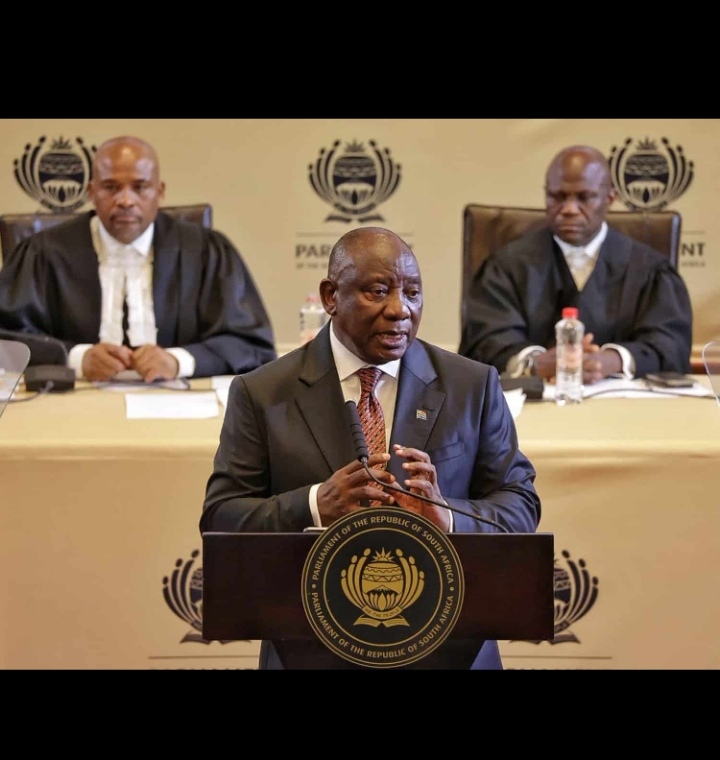


On 6 February 2025, President Cyril Ramaphosa delivered South Africa’s State of the Nation Address (SONA) at Cape Town City Hall, opening the 7th democratic Parliament and the first under the newly formed Government of National Unity (GNU) following the 2024 elections. Speaking under the theme, “A nation that works for all,” the President reflected on 30 years of democracy and outlined a forward-looking policy agenda amid South Africa’s G20 Presidency.
Economic recovery was front and centre. Ramaphosa stressed that the government’s top priority is to lift economic growth above 3%, describing it as crucial for job creation, poverty reduction, and improved living standards.
To drive growth, he announced a R940 billion infrastructure investment over three years, focusing on transport, energy, and water systems to unlock economic activity and create employment. He also pledged a R20 billion fund to support small businesses, recognising them as key drivers of innovation and jobs.
The President did not shy away from acknowledging weaknesses in local government. Many communities continue to struggle with water, electricity, waste collection, and infrastructure maintenance. Ramaphosa emphasised reforms to boost technical capacity and financial sustainability at municipal level, noting that a capable state “begins at the communities where people live and work.”
Education and youth empowerment were also highlighted. Ramaphosa praised the country’s matric pass rates and linked education and skills development to economic inclusion and long-term growth.
The address reinforced the government’s commitment to the Medium-Term Development Plan, which focuses on inclusive growth, poverty reduction, and building an ethical, capable developmental state.
On corruption and accountability, Ramaphosa highlighted efforts by the Special Investigating Unit (SIU) and the Asset Forfeiture Unit (AFU) to recover funds lost during the state capture era. He also promised to strengthen anti-corruption measures, including a Whistleblower Protections Bill to safeguard those exposing wrongdoing.
While many welcomed the ambitious framework and emphasis on unity under the GNU, critics pointed out a lack of detailed timelines and measurable targets, especially in areas like crime prevention and municipal service delivery.
On the global stage, Ramaphosa reaffirmed South Africa’s commitment to strengthening trade and diplomatic ties, linking this to the country’s G20 leadership role and broader goals of promoting peace, development, and inclusive economic growth internationally.
Reactions to SONA 2025 were mixed. Supporters praised the ambitious agenda, while skeptics questioned whether promises on infrastructure, small business support, anti-corruption, and municipal reform would translate into tangible results without stronger implementation mechanisms.
As South Africa continues to face deep socio-economic challenges, the true test of SONA 2025 will be in execution and delivery. Citizens now look ahead to the next State of the Nation Address, scheduled for 12 February 2026, where progress on these commitments will be assessed.